Note June 2018: Mira AP has been replaced by Mira Pro.
This news note describes how amateur astronomer Ronald Bissinger of Pleasanton, CA, used our Mira AP software to detect the eclipse of HD 149026. The observations were made over 3 nights beginning June 29, 2005. His analysis confirmed the predicted 0.003 magnitude dimming during eclipse. [Skip to Results].
Introduction
On June 30, 2005 a team of astronomers led by Dr. Debra Fischer (San Francisco State University) announced the discovery of a planet orbiting the Sun-like star HD 149026. This discovery was made using the radial velocity method, which measures subtle wobbles in the star's velocity along the line of sight caused by the gravitational influence of its orbiting planet. Based on these measurements, the new "exoplanet", known as HD 149026b, has a mass similar to Saturn and a diameter about 6% as large as the star [research paper]. But there is another way to detect exoplanets — one that does not require a large telescope equipped with a high resolution spectrograph: "Transit Search". The largest, most detectable changes in radial velocity occur for those exoplanets whose orbital plane is inclined to match our line of sight, thus producing an eclipse as the planet transits the star once per orbit. Exosolar planets are too far away to be seen directly, but they may be detected by observing the dimming of starlight during the eclipse. The transit search method can be done using a modest size telescope but requires extremely precise measurements of the star's brightness.
Exoplanet Detection
Detecting exosolar planets is an extremely difficult pursuit. This method requires luck of timing to catch an eclipse, the acquisition of high quality image data, and the application of sophisticated techniques for image processing and measurement. In the case of HD 149026, the eclipse blocks approximately 1/300th the star's surface, dimming its light by only 0.003 magnitude, or 0.3%. An eclipse of this degree cannot be detected unless the photometric measurements have a consistency approaching the milli-mag level over a span of many images (0.001 magnitude variation means that the brightness variation is about 0.1% of the signal). Making such precise measurements over many images pushes both the technology and experimental technique to the limit. Exosolar planet surveys have been the dominion of a handful of professional astronomers using relatively large telescopes... until now. Using our Mira AP software, Mr. Bissinger has pushed back the observational frontier and has shown that the field of exoplanet discovery is now open to others using comparatively modest equipment along with Mira for processing and measuring the data. Detecting a predicted eclipse differs from discovering one only in terms of knowing what to observe at what time. If such small fluctuations can be measured, then they can be discovered using appropriate software techniques.
Shortly after the discovery of HD 149026b, Mr. Bissinger was asked by astronomer Dr.' Gregory Laughlin (University of California at Santa Cruz and TransitSearch.org) if he could observe the upcoming transit to assess the possibility of amateur astronomers to detect such marginal events. Accepting the challenge, he acquired some 100 images on the evenings of June 29th, July 2nd, and July 5th, 2005 using his 14 inch Celestron telescope and an SBIG CCD camera. He employed Mira AP for calibration of instrumental effects such as bias, dark, flat field, and cosmetic defects. Then he used Mira AP to make photometric measurements of HD 149026 and comparison stars in the same field of view.
Results
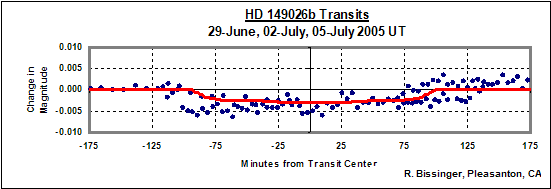
The 0.003 magnitude eclipse is clearly shown in the graph below, provided by Mr. Bissinger. Were the photometry not of sufficient precision and consistency from image to image, the subtle 0.003 magnitude dip would have been lost in the noise. The red curve shows the prediction by a theoretical model for a planet eclipsing 1/300th the area of the star.
Why is this Work Important?
The remarkable aspect of these observations is not just detection of the eclipse, but that they were made from Mr. Bissinger's backyard observatory under the bright skies of suburban San Jose, California. Although a few amateur astronomers have previously observed larger exoplanets having deeper eclipses of the order of 0.02 magnitude, Mr. Bissinger's processing and analysis techniques have moved the transit search field into a new realm. By detecting an eclipse of only 0.003 magnitude depth — some 7 times higher in precision than previous results — he has demonstrated the possibilities afforded by combining the best instrumentation and software with expertise and impeccable technique. From a scientific perspective, pushing down the threshold size of detectable exoplanets can provide dramatically better statistics about the frequency and nature of planetary systems around stars other than the Sun.
Says Mr. Bissinger:
"While the usual dark frames and flat fields were used to increase the precision of the photometry done using Mira AP, it was the software's excellent background correction and the ability to use elliptical apertures that pushed the precision to high levels. During the 40 second exposures, small tracking errors produced slightly elongated star images. Matching the elliptical apertures to the star profiles gave enough extra increase in the signal to noise ratio to make it possible to get measurements of this quality."
Astronomer and director of the AAVSO, Dr. Arne Hendon, described the precision of Ron's results as being something many professional astronomers dream of, but never reach.